Monday, September 25, 2017

Calgary: Pathway and Bikeway System

Given the opportunity to exercise I LOVE to cycle.  I am certainly no expert and don't necessarily possess the best gear or have the best style.  But I love jumping on my 2-wheeler - preferably in perfect weather conditions, I do confess! - and expend some pedal power energy.
If I can note one thing about the City Planners of Calgary it is that they have prioritized the opportunity for both locals and visitors alike to explore the 825 square kilometres of metropolitan Calgary via paved pathways.  This pathway system - one of the most extensive in continental America - is extremely well maintained.  Many well-frequented sections are vigilantly kept clear through the snowy winter months to encourage pedestrians, runners and cyclists to develop and continue healthy commuting, exercise and recreational habits!  The City of Calgary website indicates that there are 900km of pathways and 400km of on-street bicycle routes within Calgary.  It is unlikely that you would find yourself anywhere in the City limits that doesn't have access to the well demarcated and signposted system within a few blocks of where you are.

The pathway southbound alongside the Deerfoot
heading to Downtown [DD, 2014)]

The City continues to expand the pathway network that criss-crosses it from quadrant to quadrant like a fine blood capillary system, enabling users to commute from distant neighbourhoods to the Downtown core and beyond.  As a one-time employee of the Downtown Core I was able to mount my bicycle in the far northwest quadrant and complete the 21km cycle from my doorstep to my office in 50 minutes come rain or shine, wind or ... no, not snow.   I did attempt this commute on one frosty morning just before sunrise.  Unfortunately not more than a kilometre from home I took a tumble off my bike as I turned a sharp corner on the pathway where I failed to notice some black ice in the pre-dawn sunrise.  I limped my way home and resorted to the bus instead.  This was a reminder that I needed to exercise extreme caution during inclement weather conditions.  However, in the long run, this incident didn't hinder me from still racking up some decent commuter mileage that summer season thanks to the pathway system.


The pathway along the Bow River approaching
Downtown in the Fall [DD]

The pathways are free for use by all forms of commuters and exercise addicts: cyclists, runners, in-line skaters and those out walking their dogs or pushing strollers.  The paved pathways are divided into two lanes by a solid yellow painted line indicating that, similar to road commuters, users should keep to the right hand side and pass on the left.  This may be tricky at times when some users cycle, run or walk next to one another.  To warn slower pathway users of their approach, bells are mandatory for all urban cyclists.  A speed limit of 20km/hr is posted on the pathways - sometimes slower in some sections.  I've yet to see this enforced and, as a commuter I have to say this is not always a practical speed, but is indicative of how the City does try to maintain rules and some form of etiquette on the pathway system.  In some rare cases, for example near Downtown, along the River (along parts of Memorial Drive alongside the south lane) and in some parks (e.g. North Glenmore Park) the pathway is segregated for exclusive cyclist or exclusive pedestrian use.

It should be noted - and I understand that this is enforced - that NO powered vehicles are allowed on the pathway system.  This includes ATVs, quad bikes, scooters or motorized bicycles requiring a license to drive on a main road or neighbourhood street.  Segway, motorized wheelchairs or other equipment used by disabled commuters are generally exempt from this restriction.


Examples of on-street cycle lanes [DD]
During 2015 a more deliberate push by the City saw several Downtown arterial routes modified to include dedicated cycle lanes.  Cycle-specific traffic lights were implemented, traffic light timings were adjusted, and two-lane road traffic systems were changed to one-way systems in an effort to facilitate increased cycle commuting into the Downtown and to enhance cycle commuter safety.  Strategically positioned monitoring systems enable the City and street-level pedestrians to track bicycle lane usage.  While applauded by most of the cycle fraternity this wasn't necessarily welcomed with the same excitement by pedestrian, automobile and other street users.  Although this mindset change has been slow, cycle commuter awareness has definitely increased in the City.  Cyclists should still remain extremely vigilant and defensive while navigating the dedicated cycleways and intersections of these on-street bicycle routes!

On that note, I will be sharing some sights, sounds and experiences in future writings that I have enjoyed from my 2-wheeled vantage point in and around Calgary in the hopes that you, too, will be encouraged to get out and rack up some mileage on our City's extensive pathway system.

Calgary: A Beginners Guide to "Getting Around 101"

If you're arriving in Calgary for the first time it may be helpful to know how to get around from a "Planes, Trains and Automobiles" perspective.

I've already provided my insights on the geographical lay-of-the-land in a previous Blog entry.  Using this critical piece of correspondence you may want to mentally overlay it with what I'm about to share with you below if you want to navigate your way around our City with relative ease.

Here is a snapshot of my previous rudimentary City map overlaid with some transportation considerations that I will refer to later.

Calgary Schematic Layout Showing C-Train Routes [DD 2017]


The Calgary Train (or C-Train or LRT, as it is also referred to) lines and routes are highlighted in yellow on the map above.  There are several key things any new commuter on the C-Train system may need to be aware of:
The C-Train Downtown [DD]
  1. The C-Train does not have any access to the Calgary International Airport (YYC)!  So if you're arriving in Calgary via YYC for the first time and you are hoping to catch the train to your final destination directly from the airport, this is not possible.
  2. Currently the C-Train has two lines.  The RED line links the NW city quadrant originating at the Tuscany LRT Station to the SE where it terminates at the Somerset/Bridlewood LRT Station.  The BLUE line originates in the NE city quadrant originating at the Saddletown LRT Station and terminating in the SW quadrant at the 69th Street LRT Station.
  3. The RED and BLUE lines share common tracks and LRT Stations in the Downtown Core where the train line runs along 7th Avenue South.  This section of the two shared lines is called the 7th Avenue Free Fare Zone.  Commuters are able to catch the train in this section without paying any transit fare.  This is very helpful to know if you're a visitor to the Downtown!
  4. Outside of the Free Fare Zone you WILL require proof of fare payment.  A train ticket can be purchased from vending machines at all LRT Stations.  A ticket must be validated by sliding it into the "Validate Here" slot on the ticket vending machine which will stamp your ticket with the date and time of travel prior to climbing on the train.  The ticket must be kept as proof of purchase if asked to be seen by Transit Authorities on an ad hoc basis!  
  5. Your train ticket can be used to transition to a city bus service if you need to catch a bus from an LRT station to your final destination.  You will require your original validated train ticket to show to your bus Driver as proof of payment!
  6. Remember that the NW and SE quadrants are connected by the RED line and the NE and SW quadrants are connected by the BLUE line.  If you travel from the NE and need to get to the SE or NW (as an example) you will need to switch to the appropriate RED line train when you reach the 7th Avenue Free Fare Zone.
  7. Trains run 24 hours a day, 7 days a week.  There is limited service late at night, on weekends and on public holidays, so be aware of this when planning your travel.
  8. A future GREEN line that runs from the SOUTH of the City, through the Downtown Core and to the NORTH is being planned by the City Developers but is unlikely to be available until after 2021.

The Calgary Transit (CT) Bus service operates regular routes throughout the rest of the City.  The City runs a desktop and mobile-friendly App that can be used for planning your commuting route.  Some helpful tips regarding the bus system are:
  1. Bus tickets can be purchased from the Bus Driver as long as you have the exact change required!  Your bus ticket is valid on the C-Train as long as you ask your Bus Driver for a transfer (which acts as your proof of payment for your bus trip).  If you board the train and are asked by Transit Authorities to see your ticket, you will need to produce a valid transfer stub that you picked up from your connecting bus trip.  Conditions do apply to use of a bus transfer on the C-Train or a C-Train ticket on a bus route.  These will be commented on later in this Blog entry.
  2. Several buses might be labelled by a route number followed by "BRT" on the front.  "BRT" stands for "Bus Rapid Transit" and is like an express bus, stopping at fewer scheduled stops along its route.  Bus stops for the BRT routes are identified by red marker signs at their respective stops, unlike the general bus routes which are usually black and white.  Most BRT routes link distant neighbourhoods to the Downtown Core, the buses are frequently concertina-type / articulated vehicles, and they run more frequently during peak traffic / commuter periods.  Consequently they also tend to be very full of passengers!
  3. There is a City bus that connects the Calgary International Airport (YYC) to the Downtown Core.  This is good news for any Tourists.  You will want to use the 300BRT bus for your connection between YYC, the Downtown Core and the rest of the city public transit system.  Buses leave on a regular schedule from YYC and head down Centre Street making infrequent stops en route to the Downtown Core.  If you are arriving at YYC on an inbound flight you will need to ask at Airport Information where to catch your 300BRT bus and also where to purchase a ticket or get change if you do not have the exact bus fare available in cash.
A valid bus or train ticket is required for each travelling commuter older than 2 years of age.  As eluded to above, a critical point to make note of when using City Transit (Train or Bus) is that your ticket or bus transfer stub is only valid for 90 minutes from your time of purchase!  You are able to use your ticket or transfer stub for as many bus or C-Train rides as it takes to get you to your destination, but once your 90 minutes has "expired" you may be eligible for a fine if the Transit Authorities ask to see your proof of purchase and you are outside of your 90 minute window.  Fines are hefty and not worth the risk if you're outside of your 90 minute window of travel or if you can show no proof of ticket.  Remember that this does not apply to travel in the C-Train downtown Free Fare Zone where travel is always free on the Train.

Numerous taxi cab companies service the City.  Three of the most ubiquitous companies are Calgary United Cabs, Checker Cabs and Associated Cabs.  At the time of publishing this Blog entry the ride-sharing service, Uber, was operational in Calgary although it is tightly regulated so ride availability may be a little limited or wait times might be a little longer than in other international cities.
Associated Cabs has exclusive rights for commuter pick-up from YYC.  However, any taxi company can be used for taking commuters to YYC.

Note that all paid transport departing from YYC, i.e. 300BRT bus and Associated Cabs taxi rides are subject to airport taxes and as a result will incur a slightly higher charge than the same distance / time commute for pickup at any other location off-airport, i.e. away from YYC.  This surcharge does not apply to commutes that terminate / drop-off at YYC.

Use of private or rented automobiles in and around Calgary is plentiful.  As a private commuter,   navigating around the City by automobile is pretty easy.  Peak driving hours are between 07h00 to 09h00 and 15h30 to 18h00 on working weekdays, during which time the main arterial routes to and from Downtown tend to be slow-moving.  Calgarians, as with all North American countries and cities, drive on the right hand side of the road.  This is good and important to know as a first time visitor to North America!  Most rental and privately owned vehicles have automatic gearboxes which makes navigating a city, new roads, potentially icy winter conditions and busy traffic that much easier.
Calgary has no toll roads or bridges within the City limits.
For driving speeds and distances, Canadians use the metric system.  Speed limits are demarcated in kilometres per hour (kph or km/h) and distances are referred to in kilometres (km).  Vehicle speedometers are calibrated according to the metric system but the dials also show miles per hour on the inner speedometer dial.  In general, high way speed limits are 100km/h, main roads are 80km/h, neighbourhood limits are 50km/h, and school zones / public parks are 30km/h.  Speed limits are strictly enforced!
Parking Downtown is  generally expensive, limited and closely monitored!  Pay close attention to signs, roadside demarcations that might restrict parking zones or parking times, and be sure to pay for your parking at the electronic pay station assigned to your parking zone.  Parking can be paid for by cash or credit card.  Plans are underway for mobile pay options to be implemented in the City in the near future.  Note that in many residential neighbourhoods parking is limited and a permit may be required to park there.  Such permits are usually offered to residents of that neighbourhood so you may not park there unless by prior arrangement and then must display such a permit.
Parking for people with disabilities is prolific around the City as long as you are able to display a valid "disabled" sign in your vehicle.
Alberta does not require that an Albertan-registered vehicle have a front licence plate / number plate.  Don't be alarmed if your vehicle does not have one.  They are not required if your vehicle is registered in Alberta.
It is highly recommended that your vehicle be fitted with winter tires suitable for driving in the icy conditions that may prevail from October through to March.  Winter tires do NOT guarantee your safety; safe driving habits and caution are more likely to save you.  However, winter tires may go a long way in granting you peace of mind when driving, so consider this when renting a vehicle.  Note that if you are using a rental vehicle to commute to another Province you will need to ensure that you are familiar with the rules in that Province.  As an example, fitting winter tires to your vehicle is mandatory in British Columbia between 1st October to 31st March while this is not a mandated requirement in Alberta.  You need to ensure that your vehicle is equipped accordingly otherwise you may be fined.

Use of motor cycles is significantly less common in Calgary and is primarily limited to recreational purposes by bike owners.  Specific motorcycle licensing is required in order to rent or own a motorcycle of a specific engine size.  I am not covering the ins, outs, benefits and precautions of owning or riding a motorcycle in this Blog.

Finally, cycling is a great way to see Calgary.  For understandable weather-related reasons the season for cycling is limited primarily from mid-Spring to whenever the pathways might become icy or when the snow flies.  That being said it is not uncommon to see die-hard commuters cycling in the dark of winter, but this is not recommended for the feint-hearted or the under-equipped!  There is more information that will be provided in a subsequent Blog entry entitled "Calgary:  Pathway and Bikeway System" about getting around the City by bicycle or on foot!

Calgary: A Simplistic Guide to an Overview of the Lay-of-the-Land

As a newcomer to the City of Calgary one quickly has to learn the lay-of-the-land if you want to have any confidence in navigating from point A to point B.  Even though the skill of self-navigating has fallen by the wayside with the modern day ease of access to GPS technology, it's still worthwhile having a basic understanding of how your surroundings are laid out.

I'm going to try to achieve that here.  Any newbie to Calgary needs to understand how aspects of the City work, not least of all the "address" system.  I found this to be a very helpful orientation exercise when I landed here in August 2012.  A reference to the schematic below might help my description that will follow.


Schematic layout of Calgary (DD, 2017)

Calgary is segmented into four quadrants which are referenced in almost every single street address in the city, i.e. NW, NE, SW and SE.  Memorial Drive divides the city into North and South, while Centre Street (or its extension, Macleod Trail) divides the city into East and West.
The centre of the city is effectively at the intersection of Memorial Drive and Centre Street, just at the north end of the Centre Street Bridge.  "Downtown Calgary" is located just to the south of Memorial Drive on the southern banks of the Bow River, straddling Centre Street.  
In general, all avenues run in an east/west direction and all streets run in a north/south direction.
Stoney Trail is a ring road that nearly defines the edge of the city limits.  The southwestern section of Stoney Trail is still under construction.
Two other key roads are 16th Avenue North (i.e. 16th Avenue that runs east-west and is located north of Memorial Drive, not to be confused with 16th Avenue that is located 16 blocks south of Memorial Drive referred to at 16th Avenue South!!) and also Deerfoot Trail.
16th Avenue North (or 16th Ave N) becomes the TransCanada Highway, or Highway 1, outside of the city limits.  If you continued west of Calgary on this highway you would eventually land up in Vancouver, BC.  Continuing east of Calgary will take you to the Atlantic Provinces in the East!
Deerfoot Trail is a main arterial route running north-south across the eastern part of the City and is also referred to as Highway 2.  Heading north on this highway will eventually bring you to Alberta's Capital City, Edmonton some 300km away.  Heading south on Highway 2 will eventually bring you to the USA border.  You will want to have your passport ready if you land up here!

If you are arriving in Calgary by airline for the first time you will no doubt be landing at Calgary's International Airport, known fondly to locals as YYC, the City's international airport code.  YYC is located in the northeast quadrant of the city.  Be sure to check that any address you pass on to taxi drivers, friends or your fellow travel companions is always specific to the quadrant you need to be in.  Requesting a taxi service to take you to 7007 14th St could land you up at any of four locations: a great sushi location in the NE, Nosehill Park in the NW, Rockyview Hospital in the SW or at a non-existent location in the SE!

Hopefully this provides you with a helpful framework to orientate yourself so you can start discovering the City for yourself.  Alternatively, you could stay with me a little longer and I'd be thrilled to introduce you to some of my favourite spots across this ever-changing landscape.

Introducing Calgary: Be Part of the Energy

As a permanent resident of Canada and, more specifically, a home-owner in the oil and gas-driven City of Calgary I have come to love this place not only for its diversity of cultures but also because of her people, seasons, climate, landscape, geography and - not least of all - the rapid weather changes.

Aspects of Calgary remind me so much of Johannesburg, South Africa: the shortness of breath you experience when climbing stairs because of its high elevation, the electrostatically charged dry and drab winters, the powerful summer thunderstorms, the unique and massive cumulonimbus clouds that  sometimes dominate the otherwise uninterrupted big sky.  It differs vastly from Johannesburg by virtue of its easy access to the awe-inspiring Canadian Rocky Mountains to the west and the seemingly endless Prairies to the east, the amount of snowfall in winter and the associated Arctic-type temperatures, the unique Chinook winds that suddenly blow from the west off the Rockies and can raise the mid-winter temperatures from -25C to +10C within hours, melting snow and ice and bringing with it the onset of migraines and other unexpected medical conditions.  The lazy Bow River that snakes through the city introduces unique opportunities and a certain charm that may always elude a place like Johannesburg.  And so there is much to embrace, enjoy and encounter in this delightful city.
Calgary Skyline and Chinook Arch at Sunrise [DD]

Founded in 1875, the Calgary Metropolitan Area now has a population of over 1.3 million people (2016) and is reported as the 4th largest Census Metropolitan Area in Canada.  Previously known as "Calgary: Heart of the New West" but recently rebranded as "Calgary: Be Part of the Energy", she remains the headquarters for numerous Canadian-based Oil and Gas corporate offices as well as home to the Calgary Flames (National Hockey League) and Calgary Stampeders (Canadian Football League) and Calgary Roughnecks (National Lacrosse League).  The City's sporting facilities and hosting capabilities were escalated on the global stage by her successful hosting of the 1988 Winter Olympics.  That event left its mark through numerous tourist attractions including Winsport COP (Canada Olympic Park), Olympic Plaza and the Olympic Oval.  Even the design of the iconic Calgary Tower is likened to the olympic torch.  Never is this more evident than on those rare occasions when the City celebrates key events by burning the flame atop the tower!

Calgary Skyline - Canada Day Fireworks and flaming Tower [DD]

Despite her relatively short history Calgary is not found wanting in the areas of architectural attractions, recreational opportunities, scenic beauty, parks and gardens, museums, entertainment, events, shopping and lodging.  When diverse weather conditions are thrown into the mix then this City is really able to showcase her multi-faceted offerings, confirming that a visit here in Spring, Summer, Fall or Winter will only prove to locals and visitors alike that She is, indeed, a City for all Seasons.
So amid an ongoing and seemingly interminable lull in the oil and gas sector is seems perfectly right to recognize the wealth deposited in and around Calgary through her natural, artistic, culinary and hospitality resources and proclaim this to the rest of the world.

Sunday, May 27, 2012

Nail-biting in Nigeria

I recently (Friday 18th May) returned from what could possibly be my last visit to Nigeria.  As I did that I felt somewhat compelled to revive my blog and capture a few of my recent Nigerian thoughts.  Inspired in part by my sister-in-law’s (Lesley) recent very inspirational appearance on the blogging scene [http://viverapericolosamente.wordpress.com/2012/03/17/2012-just-do-it/], coupled with my dear wife’s delightful posts (and great writing!) about our adventures in Africa [http://cmdelmar.blogspot.com/2012/05/i-dids-of-march-i-jokingly-told-derek.html?spref=fb], I figured I should pick up and then close off on my Nigerian chapter from encounters I experienced here back in 2008 during my first visit to this part of the African continent.

I met for dinner with an old friend and ex-Unilever colleague (together with some other colleagues) last night.  My friend, Nana, captured some very appropriate aspects of how I’ve felt again this week being back in Nigeria, following his recent relocation here from Ghana [http://nanaaweredamoah.wordpress.com/2012/05/17/eko-encounters-a-tale-of-one-wrong-turn/].  I can’t help but find that this place (Lagos) is an assault on one’s senses.  Although the population of Nigeria is 164-odd million, of which 20-odd million live in Lagos, I still somehow find it more congested and chaotic than Mumbai (India).  I’m not sure why.  I’ve only visited Mumbai once.  But there’s something so broken about Lagos that just makes everything that happens here appear to be that much more congested and dysfunctional.  And so it also seems to take so much longer to do anything.

Take for instance the inevitable travel within the city and close surrounds.
Whilst I stay in a hotel on the Island in Ikoyi, most of my work takes me to the Unilever factory about 50km west on the way to the Nigerian border with Benin.
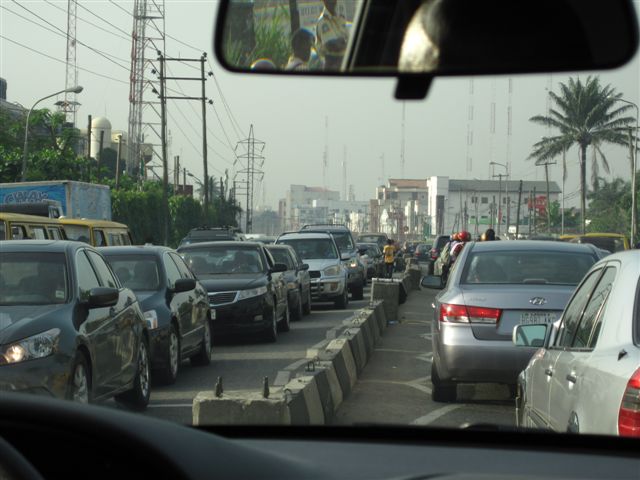
I arrived on Sunday night.  As I capture these thoughts it’s now Thursday night and I’m sitting at the airport ready to leave for home.  In these 96 hours that I’ve been here I’ve spent 20 hours driving that 50km to and from the Factory four times.  That’s a sad 20km/hr average for my journeys.  Unilever safety regulations forbid you from working on your laptop whilst in road transit in Nigeria, so this reduces one’s productivity time to a tight few hours in the office (or, in my case, the Factory), which is NOT terribly productive at all.  So I’ve spent these hours often transfixed by the passing chaos on the streets around me in my Chauffeur-driven car with my security detail alongside him in the passenger seat.  Albeit that we’ve taken mostly the same routes every day I continue to see things and places that I’d not seen in my previous days’ trips.  I can’t help but want to share some of them with you, albeit that they may have no meaning to you at all.

Enduring the daily traffic jam to / from work

Drive it to destruction ... one of MANY abandoned vehicles  in the middle of "nowhere"

Navigating the roads ahead of the rainy season

Needing a place to sit

One can buy almost anything somewhere along the road ...


Contemplating life at the end of a busy day


So much of life seems to happen alongside the main routes.  But looking down the side alleys and consciously trying to notice what was happening there I realised that life’s not restricted to these obvious main routes.  There’s a hive of activity happening not even a block away.  The place is just crawling with people doing life.  And many, it seems, probably don’t travel very far from where they live right there.  Or so it seems.  Some appear to have just gotten stuck where they are and not cared to move on.  And so they’ve ended up just ageing there, minding for and seeming to take a genuine interest in some of the little kids playing on the litter-strewn pavements, separated from the main road by a canal-come-open-sewer.  How do these people make a living?  What do they do that differentiates them from the next person that makes them marketable or capable of earning an income to stay ahead or abreast of the poverty line?  And the single informal Trader swamped by the hundreds of similar Traders around them all pedalling their similar-looking, non-unique wares.  What on earth would convince me to buy from one person and not from the next?  Clearly there’s something I don’t understand about the dynamics of this life-style that I miss out on as I am escorted past them without my camera even being able to take focus on the little girl squatting in the middle of the pavement outside of a busy shop front and relieving herself, or the kids dressed in school uniform lined up in neat rows outside of their roofless school building receiving morning instruction from the teaching staff on the days activities.  Something of this LIFE that happens amidst the chaos of scooters dodging vehicles, nobody having right-of-way, the car horn being the primary mode of communicating one’s intentions / anger / apology / presence rather than the use of an indicator; motorbikes having horns that even a 20T truck-and-trailer would be envious of!  To say it’s mayhem is a complete understatement.  But somehow it all works.  Even if it does take an inordinate amount of time to work.  When you drive, you drive fast.  When you stop, you stop for long!

One evening it took us 3hrs to make the journey home.  It turned out that a fuel tanker had somehow lost its load at a major intersection.  As we finally reached the location of the incident there was a crowd of inquisitive bystanders dodging massive pools of fuel that lay more then ankle deep in the road.  Life was still happening in the vicinity whilst this explosive threat was pouring down the street.  This delay did mean that we ended up arriving at my hotel well after dark, something I’d been directed to avoid at any cost given the heightened tensions and terrorism threats in the country.  This journey did afford me the first sightings I’d ever had in Nigeria of modified shipping containers that had been fitted with windows, mounted on old truck chassis and converted into “buses”.  I also got to see my first Nigerian / Lagosian freight trains loaded with illegal “passengers on the roof leaving town.  I’ve seen a car being washed where even the inside door panels were being hosed down thoroughly.
One evening I only got out of the Factory later, only for my driver to discover that the car battery had gone dead during the day whilst he was waiting for me.  After a mad rush about looking for jumper leads they managed to hunt down a Unilever employee who had leads; this seems to be a rarity to have these available on you.  Clearly I was “in luck”!

Unilever issued a travel advisory on my 2nd day here, changing the security status of Unilever employees from green to orange (alert) status, restricting travel into the country and certainly outside of Lagos without the Chairman’s authority.  Seems lime I made it in just in time, else this trip would have been put on hold indefinitely.  I’m not sure if the fact that I got to travel to Nigeria without question on this trip means I was lucky or unlucky in this one!

I was discovered and stopped on Unilever premises by Immigration Authorities and asked to see my papers.  Everyone in the Office (at the Factory, where this happened) was amazed that the Authorities were even on Site unannounced!  I came away unscathed and averted time in jail.  And apparently this is a good thing.  I heard from an authoritative individual today that the police service no longer have dogs or horses.  The staff (apparently) use the money to go and buy food for themselves.  Is this corruption or quiet desperation?  By inference one would not want to land up in jail for even a short time because its not sure what you’d be fed, if you’d be fed at all!

Catching a lift on a motorcycle seems to be the cheapest and most prolific form of transport.  Lagosians most certainly have an innate skill in being lifted because despite the terribly adverse on-road / off-road nature that such travel might take whilst navigating the massive and numerous pot-holes, crossing centre medians to career down the oncoming traffic lane before dodging into side streets, or just mounting the pavement to speed up the trip, the casual passenger(s) find no need to have to hold onto anything.  In fact some continue conducting business on their cell phones whilst being taken on these insane joy-rides, often even laughing and engaging with the distracted driver!  Four years ago I managed to get a photo of a passenger carrying a massive framed mirror, wedged between the passenger and the bike driver.  This time I sadly missed two classic pictures; one was the proverbial live-stock (usually a goat) being carried by the passenger.  The second was a passenger transporting a fill sized front windscreen of a vehicle, wedged between he and the driver.  How do they get that right??  I’d also previously seen a bull in the rear of a Mercedes station wagon with 4 adults in the vehicle.  Today I saw a lady loading a bull into the back of her station wagon.  Even my Nigerian colleague who was driving with me looked on in disbelief.  And here I think twice about loading my dogs into the back of my car and taking them down to the beach!!

I’m not sure why all of these “sightings” warranted comment and were imprinted onto my mind’s eye.  I wondered whether some of this happens in my world back home but I’m just so absorbed with my life that I don’t even notice it.  I’m not sure that’s the case.  I think I’d notice a lady with a bull in the back of her car.  But I think one appreciates and registers these unique sightings when one has time on one’s hands (or when you’re not behind the wheel yourself!), and when you have unique sounds, sights and smells around you.  Lagos certainly affords one those opportunities.  But it’s still a place I’m happy to visit and happier to leave.
This trip was certainly sweetened by the ease of my Sunday arrival and speedy and easy transition through customs (20mins vs 2hrs!)  You can’t be in a rush in Nigeria.  But you can always still be surprised when things do go that much smoother than planned.

I’m glad to now be headed home to be with my beloved wife who I can’t blame for not wanting to join me on this trip (despite the offer).  The luxury and delight of our recent adventure to Kenya will be a tough one to replicate.  But I know she’s going to be super-stoked to have me home again.  And I’m going to be too!!

Saturday, September 24, 2011

Au revoir, Cote d’Ivoire!

My 5 nights in Abidjan are effectively more than I'll be spending on my upcoming honeymoon.  How sad is that?  Does that mean I have my priorities misaligned?  (don't answer that!)  At least I expect I’ll have more fun on my honeymoon than Abidjan could even serve up.  Not saying that it hasn’t been a good week, though.  It has been a very tiring week.  But that was expected.  After all, I was here to work!  And work I did.
So, what do I love about CdI?  Well, the people are certainly delightful.  I did love meeting and being with them.  I had met a few of the faces before, which made my credibility and arrival a little gentler.  Despite the previous few months war, brutality and carnage the people’s spirits are incredible.  They remain so positive and quite a happy bunch.  They’re extremely friendly, I felt extraordinarily safe, and just generally enjoyed the experience.
I certainly enjoyed having my evenings to myself rather than having the local Team feel like I needed to be hosted at every waking opportunity.  So I was very happy about that.
The weather ranged from rainy and humid, to overcast and humid, to sunny and very humid.  Time in the plant around hot soap linea and steam didn’t make it any more comfortable, but it did make me appreciate my air conditioned and clean room each night!
Traffic wasn’t anywhere near bad as I expected, and although the roads are in a state of disrepair in certain areas the traffic moves remarkably well, drivers are surprisingly polite, hooting isn’t excessive, and cars don’t go missing in potholes to hell.
Buildings are pretty battered, especially along some of the main routes where ground floor windows remain boarded up or completely destroyed – no doubt as a result of the violence last year / earlier this year.
The quality of vehicles is remarkably good.  Being a former French colony these cars clearly dominate the roads.  But I was more surprised by how many NEW vehicles, including 4x4’s, are being driven.
Today (Saturday) I had a fantastic opportunity to be taken shopping by a colleague of mine.  Although I came away with various indigenous printed garments that I’m likely to never wear I did thoroughly enjoy getting into a local market, hearing the sounds, seeing the people and freshly boiled fresh chickens being defeathered (NOT!), and smelling the fresh roasted fish and other indigenous smells!!!  I felt remarkably safe and unharassed, which was a pleasant change from places like Morocco and Turkey.  Marius took me into some of the formal trade, less formal trade and then very basic rural trade.  It was great to drive around and see.  I’d probably not survive on my own – once again my French would let me down – but aside from that it was quite manageable.  Lesson to self: if you show an interest in something then be prepared to buy it.  Not because you’ll be muscled into buying it, but because you’ll leave the seller quite dejected and mildly offended if you go off and buy it elsewhere.  Even Marius – a local – avoided a store owner where I’d seen something and said we might come back, just because he didn’t want to offend him!

Well, I’m now done with Abidjan, this island-type city build around and on a vast lagoon in a Country of remarkably positive and robust, happy people.  I have enjoyed being here, albeit that I wasn’t too keen to come in the end and paid dearly in sweat and angst to get here.  West Africans truly are a delightful people.  I recall feeling the same after visiting Ghana – an immediate neighbour to CdI – some 8 or 9 years ago.

I've just arrived in Nairobi, Kenya off a 6hr flight where I'll be spending a further 4 nights.  I was "treated" to an emergency exit wondow seat only to learn that MY seat barely had a cushion AND it didn't recline.  So it was a surprisingly LONG 6hrs during which I didn't sleep at all.  Now I'm about to face a day of game drives and sightseeing which normally would be an AMAZING day out.  But given my lack of sleep - again - I think it might turn into an endurance session!!  Anyway, I'll make the most of enjoying some of the local activities on today (Sunday 25th Sept) before spending 2 days in the Factory then returning home again on the 28th

And then my REAL adventure begins.  I hear the sound of wedding bells tolling somewhere in the distance already!  21 days to go today!!  Yeah-haw!!!

Monday, September 19, 2011

Bienvenue a Cote d'Ivoire

Novotel Hotel, Abidjan, Cote d’Ivoire, West Africa
News from this roving Reporter has been pretty quiet this year, hasn’t it?  And as most of you will know, it’s not because of LACK of news on my part.  Quite the contrary!  It’s been a momentous year indeed.  The start of my 40's has been anything BUT predictable!!
I’m now back on the travel and blogging road again, experiencing my first business trip in 6 months.  I’ve loved the break from the travel.  
Early February saw me visiting India for the first time.  Late February and up to my 40th birthday weekend saw me in Algeria and a week later I was off to Turkey for 2 weeks.  All three of these trips were profound and enjoyable for their own reasons.  Yes, even Algeria (maybe because it’s the last time I’ll need to go there?).  
My 4 week holiday to Canada in July – and probably my 8th or 9th visit there – was nothing short of momentous.  I had the delight of being able to accompany my Dad and Mom across, flying into Canada to join my brother and his family there on my Mom’s birthday.  And then started my whirlwind visit that saw me return to SA just under 4 weeks later having become engaged to my old (with respect!) high school friend and sweet heart, Christa!  But that story is another whole movie franchise-in-the-making of its own!!

Instead, let me get back to present day work reality …
After numerous thwarted attempts at trying to make a long-awaited business trip to visit the friendly Ivoriennes during 2010, I once again nearly had my plans scuttled over this past weekend.  Why does my business travel somehow always make for a story instead of just being a run-of-the mill “happening”?
Like I mentioned, I’ve been trying to get to this French-speaking gem of Africa for well over a year now.  When I was all set and ready to go in early 2010 some local rebels thought otherwise and decided to re-embark on civil war efforts that left the Country in a very tenuous position and left Unilever banning all travel here.  So my plans were put on hold indefinitely.  Over recent months things seem to have settled down to a gentle simmer, so I rekindled my travel plans – not out of necessity rather than out of genuine desire – and so compiled an itinerary that would help me tick a few boxes on my work to-do list. 
A week of trials and process auditing in Cote d’Ivoire.
A 3-day courtesy visit and process audit in Nigeria.
And finally a 2 day stop-over and project review and process audit in Kenya. 
The 11-day journey was planned and just needed to be executed.  My departure date was set for Sunday September 11th (the idea of flying on this significant date and on the 10 year anniversary of the US bombings didn’t really enthral me, I must be honest).  So I was mildly relieved when one of my key raw materials for my trial had not yet been shipped from Ghana which forced me to delay my trip by a week.  I was relieved to have an extra week at home, what with the prospects of our momentous wedding occasion a mere 5 weeks away!  It just seems more settling to be home-based for now!  But alas, work still pays the bills!

I was all set and ready to fly on my rescheduled date of Sunday 18th September, when on Saturday afternoon it suddenly dawned on me that I’d not received confirmation of my travel details and my final itinerary.  Trying my best to think nothing much of it I pressed on in the rest of the weekend expecting the gnawing in my stomach to subside once I started packing.  Well, a long story short, by Sunday morning it was confirmed that I did, indeed, NOT have a confirmed ticket for my anticipated upcoming journey that I was expected to depart on at 8pm that night.  So with a mild frenzy I set about trying to establish whether there had been some accidental mess-up and what could be done to remedy the situation.  After numerous extended phone calls to the 24-hour helpline for our travel agents investigating flight routing options, times and PRICE (it’s not a good thing booking at the last minute … ever!!!), and with much angst, I managed to book a trip that would still get me to CdI on time albeit that I now had to cut out the Nigerian leg of my travel.  So after receiving final confirmation of my trip at 4.30pm on Sunday afternoon I frantically started packing, getting things ready at home for my 10 days excursion.  Despite my best intentions to be ready ahead of time for this journey when the time came to it I was hopelessly under-prepared, far from ready to leave, and severely lacking in enthusiasm to travel to Central Africa.  Even a stint in hospital seemed more appealing at the time (I hate to admit it!!).
Saturday night had seen me hosting friends at my home till quite late.  This, followed by another of those late night calls to my beloved in Canada saw me crawling into bed at 2am on Sunday morning.  The growing anxiety about my unconfirmed trip woke me by 6am on Sunday morning, so by the time I had packed my bags and was dashing for the airport on Sunday night I was already running on emotional fumes.  In my haste to park my car in my parking bay at work I promptly reversed into the wall of the prayer room in the Unilever basement car park and put a neat hole through the wooden partition.  This after almost mounting a pillar with my front tyre.  Try get that right in your car and come away unscathed!!

I can’t help but wonder if some forces weren’t conspiring to stop me from embarking on my trip to Central Africa yet again.  But undeterred I was determined to make this thing work.
Anyway, now I’m here.  And relatively unscathed.  CdI from the air as we flew in at the end of a 5h30min journey from Nairobi in the late morning looked lush and densely forested.  Massive palm plantations were immediately the most prominent feature of the landscape, with palm (kernel) oil being a key source of raw material supply, certainly to our (Unilever’s) soap making industry in this part of Africa.
My first transition through Ivorian customs was pretty effortless.  The little airport here really is very neat and quite impressive by African standards.  It’s relatively modern and clean.  And it, like the rest of the country, is very … very … very French!!  I guess it’s not called French West Africa for nothing!  There is a very basic understanding of English amongst the public servants at, say, the airport.  I happened to arrive on the same flight as the Ivorian Athletic Team (able-bodied and para-athletes) who had just been competing in the African Athletics Champs in Mozambique.  So there was much excitement and photographing at arrivals as I walked through into the arrivals area of the terminal.  My ego was momentarily boosted until I realised they weren’t there to see one of the only white faces in the terminal building; they were there to meet their athletes!  To add insult to injury, even my pre-arranged driver hadn’t pitched up.  So I was soon humbled as I have been on numerous occasions these past few hours and days!

Although very tropical, with a constant light cloud-cover that insulates the atmosphere enhancing the humidity build-up, today was pretty mild, although I do realise I was exerting no effort aside from staying awake and breathing.  Despite that I did find myself pushing out some beads of perspiration as I jammed myself into a minibus loaded with a troop of Arabic-speaking folk that drove and dropped us at various hotels.  I was glad that my hotel was one of those scheduled drop-off points!  My 6th floor room has a great view of the sprawling lagoon around which a large part of Abidjan is located.  I was supposed to have been picked up and taken off to the factory during mid-afternoon, once I’d freshened up.  But eventually my work colleague here proposed that I just stay on in my room, relax and they’ll pick me up first thing in the morning rather than try to fight the afternoon traffic to get to the Factory and back again.  So tomorrow (Tuesday) will be my first opportunity to see the facilities here and recce out the set-up so I can prepare for my soap bar trials later in the week. 

Hopefully I’ll get to update you again “later”.